The $1 Billion Failure of Traditional Driver's Ed
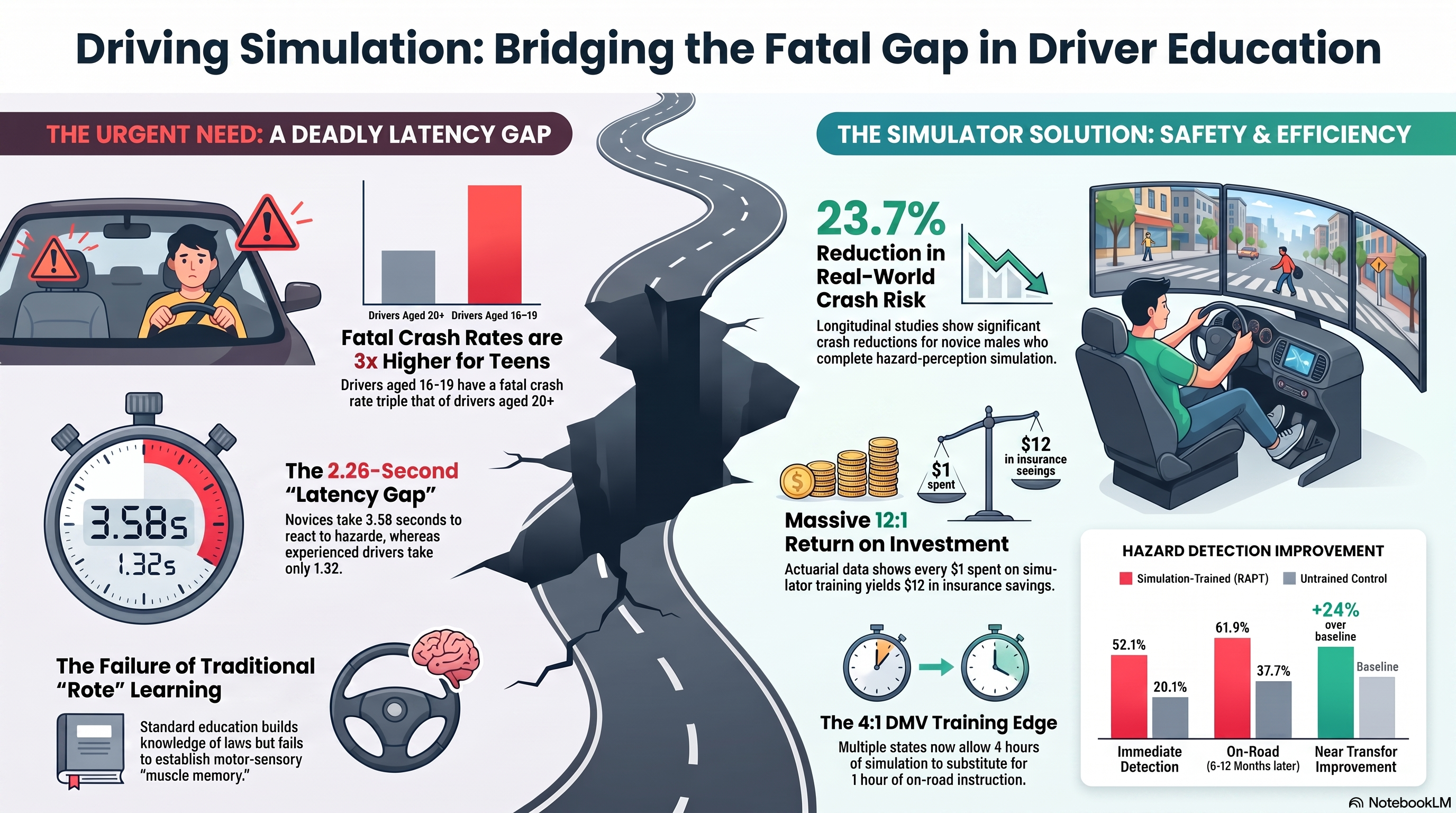
According to federal traffic safety data, over $1 Billion is spent annually on traditional classroom driver's education—yet NHTSA reports it has never been shown to reduce real-world crash rates. Traditional methods prepare students to pass a paper text, not to handle a shifting, high-stakes traffic ecosystem.
This textbook gap results in a deadly deficit on the road. Novice teens average a massive 3.58 seconds to react to sudden hazards compared to just 1.32 seconds for experienced drivers. That hidden 2.26-second delay is why novices completely fail to see nearly 40% of critical road hazards, and slam brakes with 50% less force than adults in an emergency.
At Drive Degree, we aren't relying on basic skid tricks that inflate false driver confidence. We are reengineering spatial intelligence. Peer-reviewed data shows that simulator-trained drivers anticipate critical road hazards 84% of the time compared to just 57% for untrained peers. By packing 40+ high-stress scenarios into a single 7-minute virtual run, we forge the automated muscle memory required to survive before they ever twist a real ignition key.